Major I-10 Widening Project Enters New Phase
For many of us in Ahwatukee, heading south on the Loop 202 to connect with Interstate 10 is a regular part of life. Whether you are commuting to work in Chandler or Queen Creek, heading down to Casa Grande for the weekend, or just running errands, that stretch of highway is a vital artery for our community.
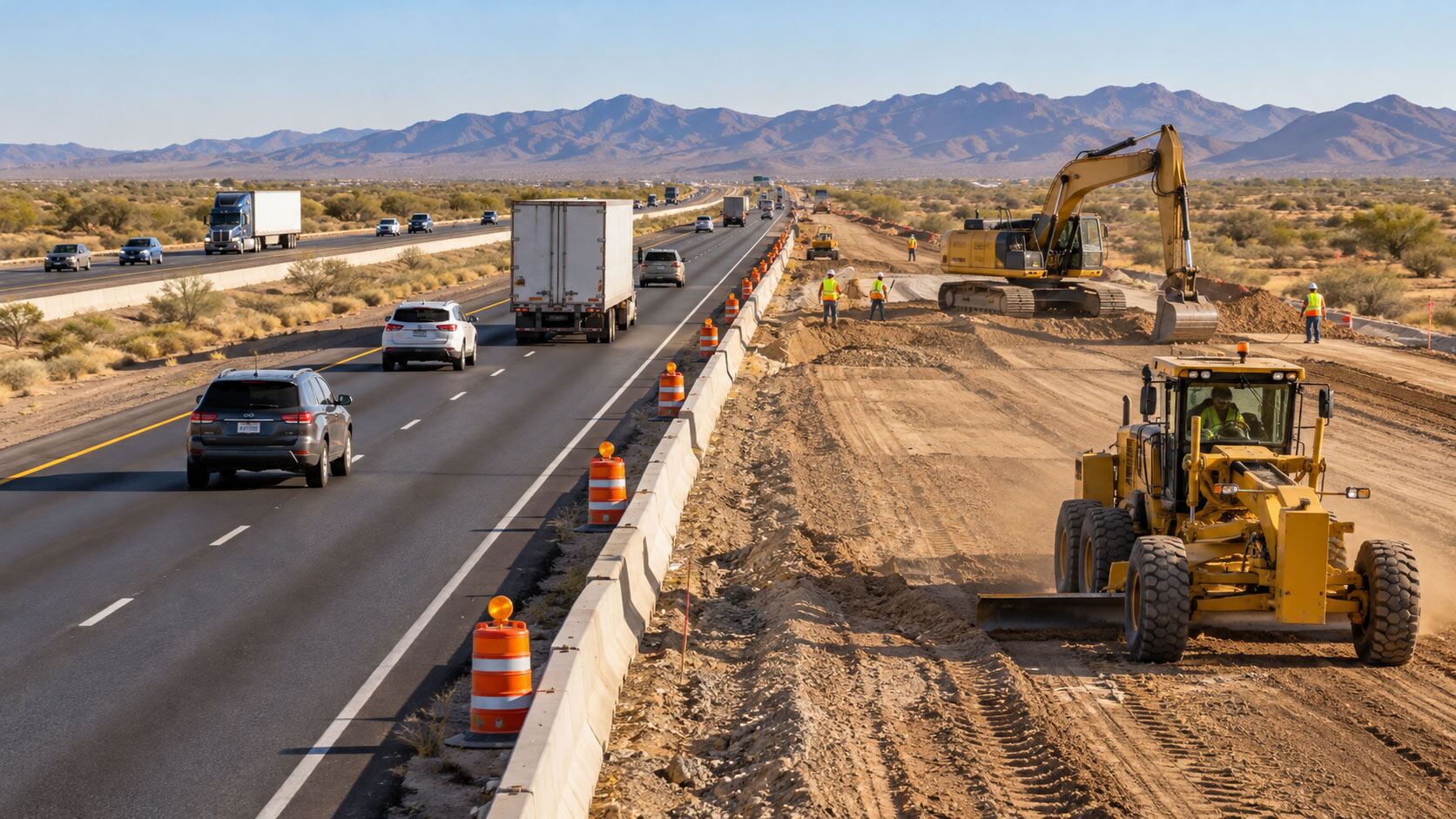
If you have noticed more construction cones and crew vehicles down there lately, you are not imagining things. The Arizona Department of Transportation (ADOT) has officially announced that the next major phase of the I-10 widening project between Phoenix and Casa Grande is now underway.
While construction always brings a few temporary headaches, this project is designed to make our future commutes significantly smoother, safer, and faster. Here is everything you need to know about what is happening on the road and how it will impact your travels.
The Details at a Glance
- The Project: The I-10 Wild Horse Pass Corridor Project (Segment 3 of 4)
- The Location: An 11-mile stretch of I-10 in both directions, starting at the Loop 202 (Santan/South Mountain freeways) and extending south to the Gila River.
- The Goal: To ease chronic congestion, improve safety, and shorten travel times for the growing South Valley population.
- Estimated Completion: All four segments of the broader corridor project are expected to be finished by late 2029.
What Improvements Are Coming?
This is not just a simple repaving job. ADOT is making substantial upgrades to this critical corridor. Over the coming months and years, crews will be:
- Adding Lanes: Installing a third general-purpose lane in each direction along the entire 11-mile stretch. Additionally, a dedicated High-Occupancy Vehicle (HOV) lane will be added in each direction between Loop 202 and Riggs Road. Rebuilding Interchanges: Major upgrades are coming to the interchanges at Wild Horse Pass Boulevard, Riggs Road, and Queen Creek Road (State Route 347) to improve traffic flow.
- Building a New Interchange: A brand-new interchange will be constructed at Koli Road, situated between Wild Horse Pass Boulevard and Queen Creek Road, providing better access for growing communities.
- Upgrading Technology: The corridor will receive modern safety and traffic management features, including new overhead message boards, freeway cameras, and advanced systems designed to detect wrong-way drivers.
The Bigger Picture: A Multi-Year Investment
This current 11-mile stretch is the third of four major segments in the 26-mile Wild Horse Pass Corridor Project. To give you an idea of the full scope:
- Segment 1: Began in May 2024, focusing on replacing the I-10 bridges over the Gila River. Finishing touches on these new bridges are scheduled for completion next month.
- Segment 2: Began in January 2026, covering 10 miles of I-10 from Gas Line Road to just north of Casa Grande. This includes adding a third lane, rebuilding the Pinal Avenue interchange, and adding a new interchange at Seed Farm Road.
- Segment 3: The current phase we are discussing, stretching from Loop 202 to the Gila River.
- Segment 4: The final phase, which will connect the remaining gaps to complete the 26-mile corridor by late 2029.
What This Means for Your Commute
We know that the word “construction” often translates to “detours and delays.” While this project will be a massive improvement in the long run, the short term will require a little extra patience from all of us.
Here are a few tips for navigating the coming months:
- Plan Ahead: Allow an extra 10 to 15 minutes for your commute if you regularly travel this route, especially during peak morning and evening hours.
- Use Navigation Apps: Apps like Waze or Google Maps are invaluable for real-time updates on lane closures and traffic slowdowns.
- Merge Early and Safely: With lanes shifting and new interchanges being built, pay close attention to overhead signs and give yourself plenty of room to merge.
- Stay Alert: The new wrong-way driver detection systems are a great safety addition, but they rely on all of us paying attention to signage, especially at night.
Short-Term Pain for Long-Term Gain
It is easy to get frustrated by orange barrels, but it is helpful to remember what we are building toward. The South Valley is growing rapidly, and the infrastructure we have today was not designed for tomorrow’s traffic. This investment will not only make our daily commutes less stressful, but it will also improve emergency response times and support the continued economic growth of our region.